Raspberry Pi Installer
Terms and Privacy
By installing the iSR Client on your computer, you understand and agree to the Terms of Service and Privacy Policy of the iShareRadio platform.
The iSR Client connects devices on your local network to the iShareRadio Hub. Once proxied and paired to an Operator on the Hub, those devices can be controlled, managed, and integrated with alerting and metrics.
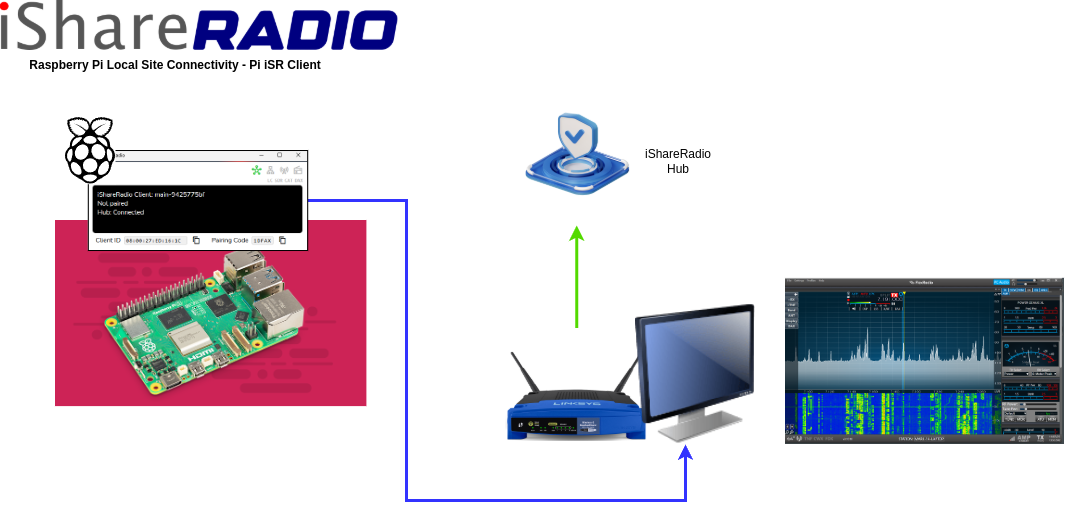
Blue: LAN, Green: WAN
The iSR Client can be installed on the same Raspberry Pi as your local hardware, or elsewhere on your network so long as it can reach those devices. The simplest approach is to install it on the Raspberry Pi.
How the Proxy Works
The iSR Client is a secure, intelligent proxy for radios and shack automation on your LAN. It communicates with local devices, understands their configuration, controls switches, relays, and collects readings. The Hub does not directly connect to your local devices and waits for the iSR Client to send status and reading information. The Hub can also send instructions to control and set various features on connected modules.
The Operator must pair the iSR Client first, then pair (add device) each proxied device.
iSR and Node-RED
The Hub will allow you to select whether Node-RED is disabled (default) or not when pairing a device.
For the iSR Client to successfully manage serial-connected hardware on the Raspberry Pi, it will by default disable Node-RED permanently. This is because only one application can connect and control the serial port.
There are more advanced scenarios where some parts of your setup can be managed by Node-RED and the iSR Client. These involve multiple serial port configurations.
Restoring Node-RED
If you wish to restore Node-RED you must disable the iSR Client and restart the Node-RED systemd service. Note, reconnecting the iSR Client will disable Node-RED.
sudo service stop isr-client
sudo systemctl disable isr-client
sudo systemctl enable nodered
sudo service start nodered
Installing iSR Client on Raspberry Pi
The Debian package installer will perform the following actions:
- Install the
isr-clientexecutable - Install a systemd service that runs the iSR Client as a service
- Install a systemd timer that checks for updates from the iSR Client release server and installs new versions automatically
Requirements: Raspbian OS with Python 3.7+
Installation Steps
- Download the Raspberry Pi Debian package from the Hub Software tab to your computer.
- Copy the package to the Raspberry Pi (for example,
/home/sierra/). - Log into the Raspberry Pi using SSH (
ssh sierra@your-raspberry-pi-ip) and install the Debian package.

Example Debian package installation
Selecting previously unselected package isr-client.
(Reading database ... 136072 files and directories currently installed.)
Preparing to unpack isr-client-main-raspberrypi-arm64-d881b3f69.deb ...
Adding group `isr-client' (GID 124) ...
Done.
adduser: Warning: The home dir /var/lib/isr-client you specified can't be accessed: No such file or directory
Adding system user `isr-client' (UID 113) ...
Adding new user `isr-client' (UID 113) with group `isr-client' ...
Not creating home directory `/var/lib/isr-client'.
Unpacking isr-client (0.main.20260413210735.d881b3f69) ...
Setting up isr-client (0.main.20260413210735.d881b3f69) ...
Created symlink /etc/systemd/system/multi-user.target.wants/isr-client.service -> /lib/systemd/system/isr-client.service.
ISR Client systemd service has been enabled and started.
ISR Client release updater timer enabled (daily 06:00 UTC).
To check service status: sudo systemctl status isr-client
Configuration: /etc/isrclient.conf (logging settings)
Service logs: sudo journalctl -u isr-client -f
To disable automatic startup: sudo systemctl disable isr-client
Release updater: sudo systemctl status isr-client-updater.timer
(disable: sudo systemctl disable --now isr-client-updater.timer)
ISR Client has been installed successfully.
You can now run 'isr-client' from the command line or find it in your applications menu.
Processing triggers for gnome-menus (3.36.0-1.1) ...
Processing triggers for mailcap (3.70+nmu1) ...
Processing triggers for desktop-file-utils (0.26-1) ...
Check the iSR Client Version
~ $ isr-client --console --version
version=main-d881b3f69
git_sha=d881b3f69
release_train=main
device_id=B8:27:EB:8D:AA:0E
Check the system service is running
* isr-client.service - ISR Client - Amateur Radio Internet Sharing Service
Loaded: loaded (/lib/systemd/system/isr-client.service; enabled; preset: enabled)
Active: active (running) since Tue 2026-04-14 05:44:07 PDT; 7min ago
Docs: https://docs.ishareradio.com/isr-client/installers/debian
Main PID: 2684 (isr-client)
Tasks: 9 (limit: 760)
CPU: 4.433s
CGroup: /system.slice/isr-client.service
`-2684 /usr/bin/isr-client --console
Apr 14 05:44:10 raspberrypi isr-client[2684]: Version main-d881b3f69 o d881b3f69 beta linux Debian GNU/Linux 12 (bookworm) (6.6.51+rpt-rpi-v>
Apr 14 05:44:10 raspberrypi isr-client[2684]: Raspberry Pi: Raspberry Pi 3 Model B Plus Rev 1.4
Apr 14 05:44:10 raspberrypi isr-client[2684]: === Device Information ===
Apr 14 05:44:10 raspberrypi isr-client[2684]: Device ID: B8:27:EB:8D:AA:0E
Apr 14 05:44:10 raspberrypi isr-client[2684]: Connecting to hub server...
Apr 14 05:44:10 raspberrypi isr-client[2684]: ==========================
Apr 14 05:44:10 raspberrypi isr-client[2684]: Console mode active. Press 'q', 'quit', or 'exit' to shutdown gracefully, or use Ctrl-C.
Apr 14 05:44:11 raspberrypi isr-client[2684]: Registered B8:27:EB:8D:AA:0E 8DDG8
You can check the iSR Client is running by opening its web status page:
http://your-raspberry-pi-ip:8123

Running Console Mode Manually
If you want to run the iSR Client on a headless Linux computer then you can use the --console flag. This is useful for troubleshooting or running the iSR Client on demand. Ensure you have stopped and disabled the systemd iSR Client service beforehand.
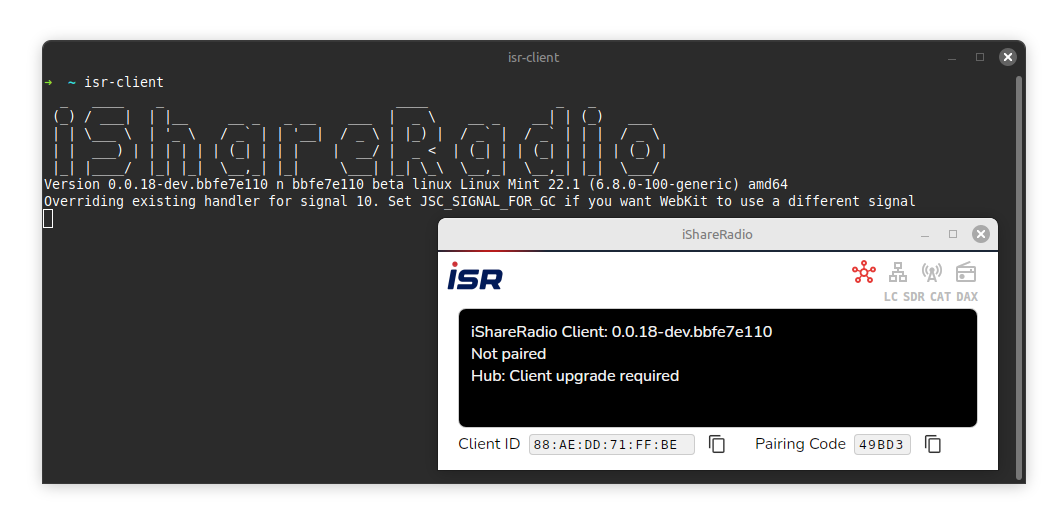
_ ____ _ ____ _ _
(_) / ___| | |__ __ _ _ __ ___ | _ \ __ _ __| | (_) ___
| | \___ \ | '_ \ / _` | | '__| / _ \ | |_) | / _` | / _` | | | / _ \
| | ___) | | | | | | (_| | | | | __/ | _ < | (_| | | (_| | | | | (_) |
|_| |____/ |_| |_| \__,_| |_| \___| |_| \_\ \__,_| \__,_| |_| \___/
Version main-d881b3f69 o d881b3f69 beta linux Debian GNU/Linux 12 (bookworm) (6.6.51+rpt-rpi-v8) arm64
Raspberry Pi: Raspberry Pi 3 Model B Plus Rev 1.4
=== Device Information ===
Device ID: B8:27:EB:8D:AA:0E
Connecting to hub server...
==========================
Console mode active. Press 'q', 'quit', or 'exit' to shutdown gracefully, or use Ctrl-C.
Registered B8:27:EB:8D:AA:0E X15Q9
Logs
For Debian installation the iSR Client will log to $USER/.ishareradio/ when run manually from the console and /var/log/ishareradio/ when run as a systemd service.